The Clash of Interpretations
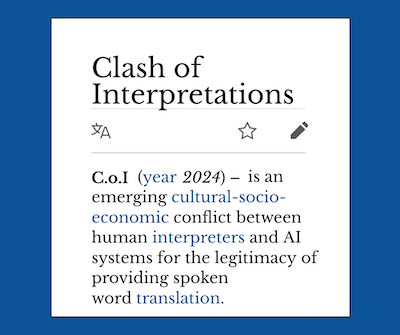
In 1993, Samuel P. Huntington introduced the world to the concept of “The Clash of Civilizations” (article available here) positing that future conflicts would be driven by cultural and religious differences. Fast forward three decades, and we are witnessing the surge of a similar kind of cultural clash—not as important as the one described by the author, to be fair, but still of some interest for people involved in translation: I name it the “Clash of Interpretations“.
The clash of interpretation is an emerging conflict between narratives around human interpreters and AI translation systems, involving companies, professionals, and researchers. It revolves around the debate on who should be entitled to translate spoken words and is a struggle for space, rights and dignity in multilingual communication. This clash is emblematic of a broader trend affecting many professions impacted by automation. After years of simmering tensions, the conflict is now becoming more pronounced, and it is fairly easy to acknowledge its existence. Playing with the polysemic word ‘interpreting,’ it is, in a way, also a clash over how to ‘interpret’ the evolving reality, and is therefore applicable to many areas affected by technological disruption.
A defining feature of this clash is the reliance on narratives rather than hard facts, on beliefs rather than knowledge. Each side feels entitled to be universally better than the other due to a strange alchemy that nobody can truly define, thus the terms of arguments are generally vague, unscientific, and mostly based on rhetoric, emotions and confirmation biases. Instead of facts, the arguments seem based on different “interpretations” of reality and are “therefore culturally “interest” driven. Sometimes, they even approach the fervor of religious orthodoxy. In this sense, they most resemble the thesis of Huntington’s article.
Recently, the clash has intensified, evidenced by the publication of petitions, open letters and position statements, on one side, and marketing campaigns and hyped claims, on the other. These are common forms of resistance and/or propaganda, but they appear often quite naive and dull. Social media has especially emerged as the perfect battleground for this narrative warfare, where posts facilitate both subtle and overt attacks. On social media, any weapon seems allowed. Gurus are easily born, and people start to follow instead of trying to understand. This clash, not to forget, is also characterized by being asymmetric in terms of power and impact on reality.
As technology continues to advance, these conflicts are likely to escalate in a never-ending cycle of verbal and ideological confrontation. Polarization will continue until the new reality sets in. Unlike the clash of civilizations, the clash of interpretations will be brief. Eventually, looking back, this clash will be seen as naive and counterproductive, and people might agree that time would have been better spent on the playground of rationality and mutual understanding.
Personally, it is deeply disheartening to witness this decline in intellectual depth and in the lack of willingness to perform investigation of the truth. It goes as far as professional associations calling for a ban on teaching AI in university translation curricula. Or companies saying that they have the ultimate solution for overcoming language barriers. When the stakes are high for those involved, intense conflicts seem inevitable. Everyone who has an interest, history teaches, feels compelled to fight to protect their own particular interests. There are many things worth fighting for. Ideally, it would be more productive to overcome clashes based on rationality, i.e. sound arguments and facts (read science). However, clashes rarely follow this ideal; they are often a messy, contentious affair.