Parrots Do Not Translate: On the Ability of AI to Understand and Translate the World
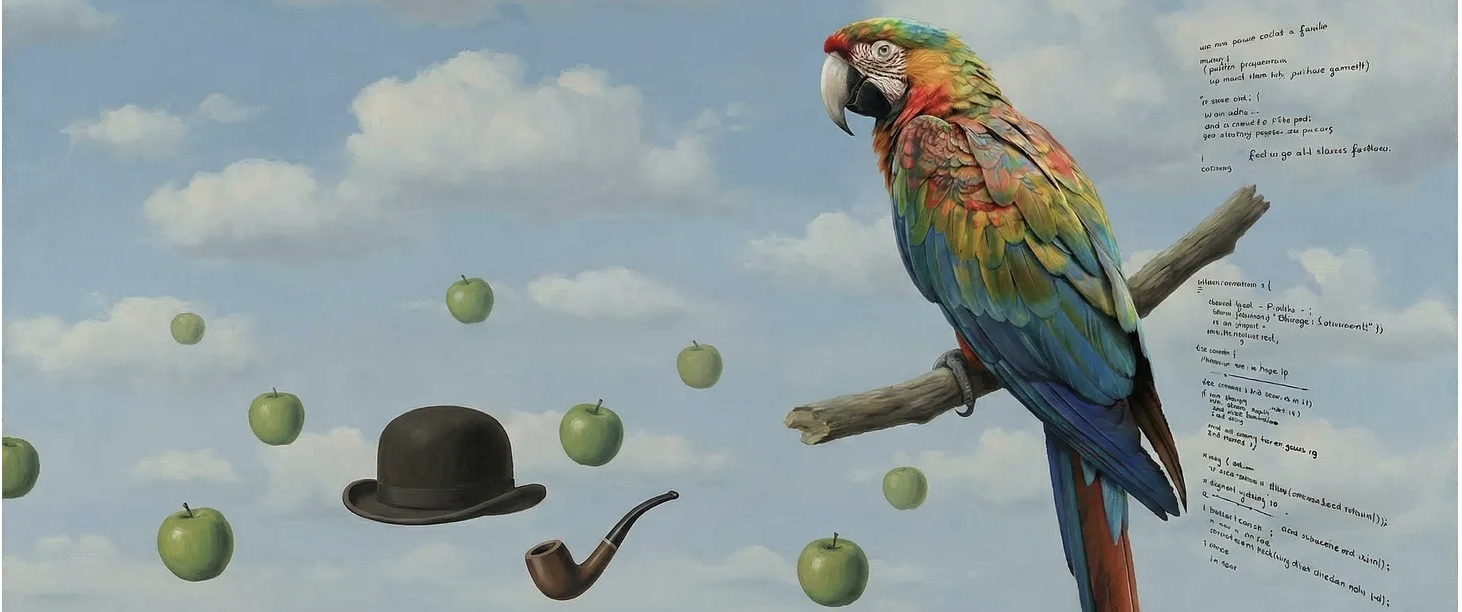
In June, at a translation studies conference at the University of Surrey, a veteran legal translator framed his keynote with a poker metaphor. Generative AI in legal translation, the abstract says, is a gambler who “cannot see his own hand. It has no idea whether it’s holding a winner or a busted flush”, because “It does not (and cannot) know the law. It predicts language.” A few months earlier, the AI special interest group of the European Language Council had published a white paper explaining that "generative tools do not understand meaning; they predict probable words".
These are just two among many examples, and not casual ones: a keynote by a respected expert and an institutional white paper. Almost everyone working professionally in translation repeats some version of this, at conferences, in public statements, in LinkedIn posts. It seems to me that the syllogism runs like this: translation and interpreting require understanding; machines merely calculate; therefore, machines cannot truly translate.
LLMs do understand meaning, though they do so in a way that is profoundly different from ours. We might call it an alien kind of understanding.
Even in autumn 2026, the belief that frontier AI systems are nothing more than statistical pattern-matchers is remarkably widespread. It is also false, at least if we subscribe to the "nothing more than". There is no longer any doubt that they grasp our language and our requests, and act on them in the world available to them, which today is mainly the digital one. The evidence is practical and empirical: they simply do it, every day, at scale. And science is starting to make "visible" what this knowledge is throgh efforts in models interpretability.
To the many people who now use these tools for complex work, such a claim may seem obvious. You just interact with the tools in natural language, and they perform what is required, with a depth of analysis and skills that certainly matches any common definition of what understanding is all about (more on this later). It is also, finally, a position shared by a growing number of scholars and philosophers. Yet we rarely hear it said in translation and interpreting. Much of our field, in industry as in academia, has not moved past its initial dismissal of what frontier models can do, and more critically the fact that they can understand. It is time it did, and time we began to think seriously about what this might mean for translation.
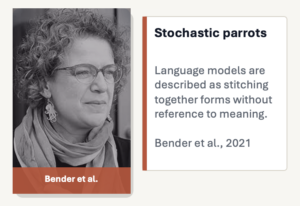
The idea that machines cannot make sense of things is neither peculiar to translation nor entirely new. In fact, it has a respectable pedigree. It goes back to a hugely influential 2021 paper in which Emily Bender, Timnit Gebru, Angelina McMillan-Major and their co-author described language models as stochastic parrots: systems that, in their words, stitch together sequences of linguistic form according to probabilistic information about how those forms combine, without any reference to meaning. The philosophical groundwork had been laid a year earlier by Bender and Koller, whose famous octopus thought experiment argued that a system trained on form alone (language) could not, in principle, arrive at understanding (meaning). This is one of the paper I most ejoyed back than. Gary Marcus supplied a plainer slogan for the same intuition: LLMs are just autocomplete on steroids.

As descriptions of the mechanism, both were accurate enough, and that point is worth insisting on. As accounts of how these systems are built, they have aged reasonably well. LLMs are trained on language (setting aside, for now, the shift to multimodal models), and they are trained with a deceptively simple objective: predicting the next word (setting aside, too, the far more sophisticated fine-tuning that follows). What aged badly was the inference drawn from these observations. Scale, together with major advances in post-training and inference-time reasoning, produced models that now perform complex cognitive work across virtually every demanding domain. The mechanism did not change. What changed is that we discovered what such a mechanism can do.
And that is where the trouble began. Rather than revisit their positions, the supporters of the stochastic parrots metaphor seem to held the line (I haven't looked into the details if the authors have revisited their position recently; Bender still defends the stochastic parrots description, albeit with some qualifications). The ideas escaped their creators, and became mainstream. The result: a plausible description of how a system is built hardened into a dogma about what it could never do or become. For a good part of the observers, the formulations settled into orthodoxy, and Bender and Marcus's positions became authorities to be cited rather than arguments to be examined, revised, and if necessary overcome. Translation and interpreting specialists, in my view, are still stuck in this parrot phase of the discussion.
The Mechanism Says Little About What Emerges From It
Let us look at what the argument actually does. It starts from a claim about what the system is, a next-token predictor, a statistical machine, and derives a claim about what it can never do: understand meaning and act accordingly. Everything rests on that leap from mechanism to capability, but the leap does not hold. Apply it to ourselves and you get: human cognition is electrochemical signalling between neurons, therefore humans cannot understand. Nobody disputes the premise. It is the conclusion that simply does not follow. Nothing in a description at the level of the mechanism licenses a verdict at the level of the capability.
If you want to know why a cat climbs a tree but a dog does not, calling both "bags of atoms" is true but scientifically useless.
The gap between these two levels, how a system works (the micro level) and what it can do (the macro level), is crucial here, and has been described very well by Nello Crisitiani in his book Forma Mentis. A cat is made of atoms and cells, but analysing it only at that microscopic level does not explain its behaviour. You need the right level of description: the animal and its behaviour. The same holds for frontier AI. Calling these systems "stochastic parrots" might be correct at the foundational level, but it does not explain why a model such as Mythos or ChatGPT 6 can find software bugs while earlier statistical spell-checkers and autocomplete routines could not. To explain that, we need to study the higher-level internal representations and the knowledge that emerges from them.
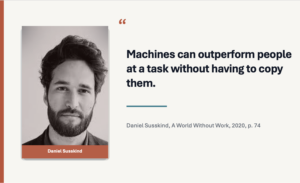
Beyond this first error, conflating mechanism and capability, many followers of the stochastic parrots make a second one: they point to the differences between how humans and machines work and learn as further proof that machines cannot truly understand. Daniel Susskind, however, reminds us that machines can match or even outperform people at a task without copying how people do it. Birds fly, and so do aeroplanes. Humans wash dishes, and so do dishwashers. A system detects a tumour in an X-ray without ever having been ill; another beats world champions without ambition or dread. In none of these cases does knowing how the machine works tell you, by itself, whether the output is any good. The aeroplane's lack of feathers does not make the flight any less real. The same applies to tasks that by definition requires understaning. Understaing our requests that we put in a prompt is surely a good whay to demonstrate understanding.
Two questions, then, need to be kept apart. One is ontological: what kind of entity is this? The other is operational: what can it do, under which conditions, at what cost, with what consequences? Stochastic parrot may have been a reasonable answer to the first. The fact that an increasingly sophisticated machine can interact with people across a growing range of domains and tasks belongs to the second.
Parrots do not translate. Frontier AI does. The mistake is not that we have mischaracterised the mechanism. It is that we have treated a characterisation of the mechanism as a verdict on the performance.
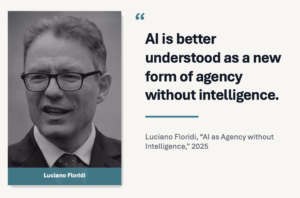
For all their spectacular abilities, LLMs certainly do not match human performance in every domain. Far from it. And it is worth understanding why. They still have intrinsic limitations, which Floridi, Jia and Tohme describe with precision. In their words, LLMs do not solve the symbol-grounding problem, the problem of connecting words to the world; they walk around it. LLMs' understanding of the world, and therefore of our requests and interactions, is derived from language, drawing on meaning that human beings have already anchored in words. What LLMs know is a shadow of what we know: what language can codify, not what experience can deliver. It is a beautiful image. They know the world - i.e the understand it - through what we, as a human collective, have written about it, not through direct experience (setting aside that agentic AI and robotics are beginning to change this, as machines start to interact with the world directly). This is certainly a limitation.
But perhaps this is what is truly astonishing: contrary to the predictions of Bender and Marcus, this shadow knowledge is proving enough to navigate the world remarkably well, as an astnished Richard Dawkins, probably the most famous evolutionist alive, points out in this interview. Navigating the world - by definition - needs some form of understanding.
Which brings us to the radical claim: this level of understanding based on language may be almost all that is needed to match human performance when it comes to translation.
What Translation and Interpreting Actually Require
The Cambridge Dictionary defines understanding as "having knowledge, a clear idea, or a mental grasp of a subject, situation, or how something works". As recent research in explainability shows, frontier models display some form of all three. Again, to be clear: nobody is arguing that AI understanding relies on the same mechanisms as human understanding. As I said in the introduction, this is irrelevant. What matters is whether this alien form of understanding, to borrow the historian Yuval Noah Harari's term, meets that definition and, more importantly, our everyday expectations of what understanding is.
For translation and interpreting, this alien understanding, built on knowledge encapsulated in language, is precisely the kind of understanding that matters. At their core, translation and interpreting have never or rarely operated on reality. They operate mainly on the words that describe reality, on Floridi's shadows. The source text is not the world; it is someone's already-linguistic rendering of it, and a translator's task is to produce another one. Is this shadow enough? I tend to think yes. Other might dsagree.
To make this more concrete: a translator does not need to have touched snow to render a Finnish winter. She gets it right by grasping what the words do: what snow contrasts with here, what it implies about isolation in this passage. Interpreters render childbirth, combat, torture and surgery, experiences they have never had and that nobody would wish on them, and we call this professionalism, not a deficiency. Of course the human translator has a body and a life; the point is that the task does not draw on them, or does so only partially or specific cases. Of course, translations 'act' upon the world. But this is something different, in my view, from describing what is needed to translate. When I worked as a translator, I translated manuals for machinery I had never seen and interpreted situations I had never lived through. I relied on world knowledge, common sense and feedback, among others, to make up for the lack of direct experience on that world. This was enough to give me the right amount of understanding needed for the task. I worked on Floridi's shadows.
Does this mean that LLMs write better code or translate as well as trained experts? Not at all. The differences are still evident, at least in certain fields. Think of translating literature or the law, for example, where AI translation still evidently misses the mark. In fact, if understanding is a prerequisite for competent translating, being able to translate does not automatically mean being able to translate brilliantly. It is probably in these cracks that we can begin to make sense of what those emerging abilities really are, whay they are like they are, what sets them apart from our own. Certainly not in the fact that machines write code or translate without understanding, while humans do.
The Bluff of the Stochastic Parrot
Why, then, does the line hold so firmly in the translation field, when a few minutes with a frontier model prove the contrary? Why other fields, such as informatics, are accepting much easier that frontier AI simply understand, and move the discussions to more fruitful terrains, such as whay do they perform as they do? I suspect the reason is less philosophical than professional. "LLMs don't understand" preserves the exclusivity of human ability. No matter what empirical experience shows us. But far more interesting questions are waiting to be asked. What are the limits of this alien understanding? How does it differ from ours? What makes human understanding unique? What is the unique “spark” that AI-generated work lacks, as that Pope Leo XIV recently put it? I believe that these would be more interesting questions to apply also to translation.
The "stochastic parrots" and "autocomplete on steroids" camp has aged badly and should be set aside in light of what frontier models can now do. These ideas had their merits a few years ago, but today they offer a false anchor in a time of profound change. LLMs, and multimodal LLMs even more so, do understand the world. They do so in a different, alien way, but one that is sufficient to accomplish an extraordinary range of tasks at an increasingly high level. I am confident that many interesting papers, conferences, discussions around translation could emerge from aknowledging this reality.
Slightly edited on 13 October 2026.